












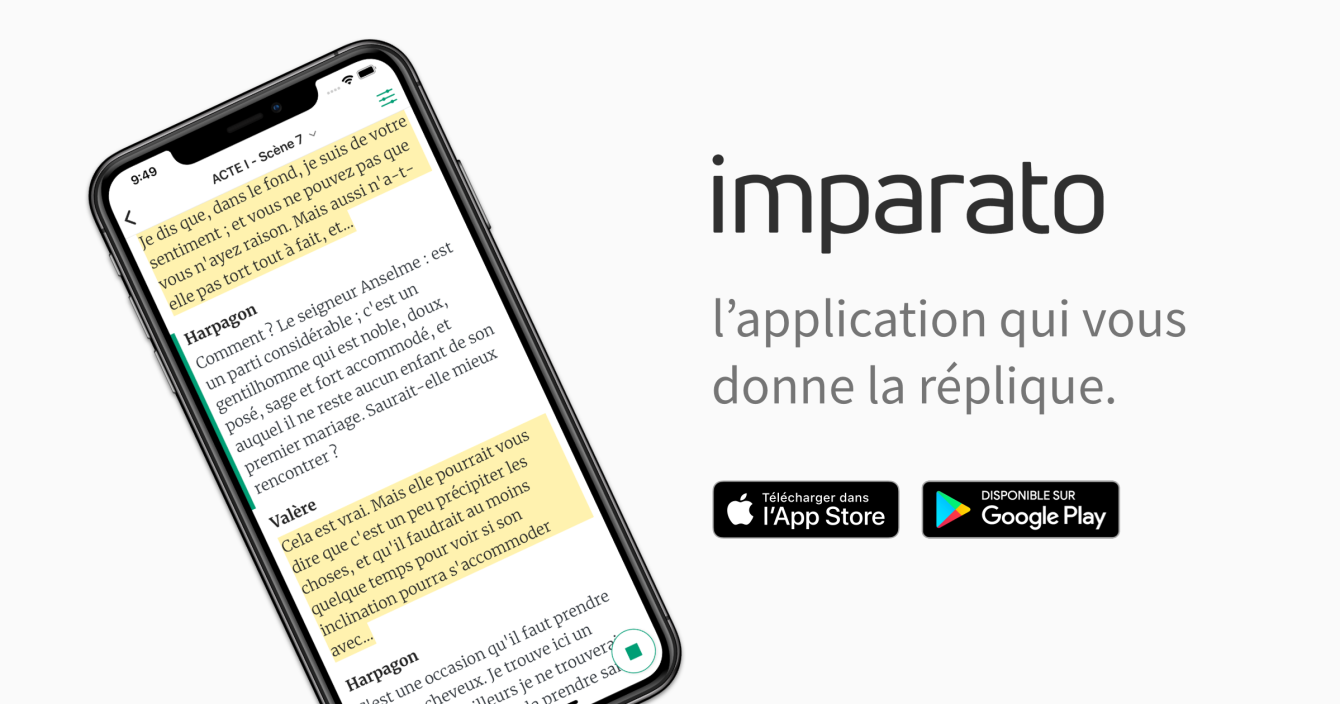
The app that gives the line 🧞♂️
Learn your plays in no time with Imparato, the app that makes actors rehearse where, when and how they want.
Discover Imparato
It's a sad fate for an orator who hesitates. Constantly forced to think about what he's going to say, he never thinks about what he's saying.
— Jean Gaichiès
Every actor wanting to practice their craft must inevitably go through the long and difficult stage of memorizing their text. In fact, it's a hurdle that discourages many people from even trying theater!
There's no single miracle recipe for learning your lines, but you should know that over time and with experience, all actors develop their own techniques to improve or speed up the process.
In this guide, we're happy to present the 12 practices most commonly used by professional actors to learn a text quickly and effectively. You'll see that some are simple, others are completely unexpected, but all are easily applicable.
Whether you have trouble retaining a text or you're already a seasoned pro, whether you have an auditory or visual memory, you're bound to find something in this list. It's up to you to identify the ones that suit you best and make them your own!
Before you start learning your character's lines, make sure you've read and fully understood the entire play and its mechanics. Who are the characters? What are the key moments of the play? How does your character evolve?
Focus on your character and their relationship with the other protagonists. For each of their lines, understand their psychology and why each word is used.
Most often, the company does a first read-through together, and that can be enough to get a good grasp of the plot. Don't hesitate to talk to the other actors or the director at that time to clear up any doubts or ambiguities regarding situations or characters.
This is a very common practice among actors: using a highlighter on your character's name every time it appears, or even on all of your lines.
This allows you to visually highlight each of your lines in the text. With a single glance, you can evaluate the volume of text to learn on a given page or scene.
It's also a way to take ownership of your script, making it a personal object that's pleasant to work with. And if highlighters aren't your thing, underline or box your lines.
Don't hesitate to take personalization even further: take notes in the margin, note your difficulties or hard passages, underline words that seem important, note your moods, change the font size if the text is too crowded, etc.
You and your script are going to go through some intense moments during the learning process. You'll love it, you'll hate it, but either way, it's your territory! Make it yours!
A few preliminary readings will help you develop a familiarity with your lines and the words your character uses. Read them several times in your head, then do it out loud. Try to feel your character through their words.
This applies to this step and all the following ones: Be scrupulously careful not to attach a particular intention to your lines. Even if your character's intention seems obvious (anger, fear, joy…), it's important that during the learning phase, you read and memorize your lines in a neutral tone (without any specific intention). Indeed, if you learn your lines at the same time as the acting/intention they inspire, you might have trouble breaking that "evil association" later—for example, when your director gives you notes that might be the opposite of the intention you had identified.
When you recite your text out loud, be very careful to do it without inflection, in the most neutral tone possible! Otherwise, you risk linking the text to inflections that you'll have a hard time getting rid of later.
Read a line slowly out loud, then try to repeat it from memory immediately after, still out loud.
When you state your line from memory, try to use your visual memory (by visualizing each word) or your auditory memory (by recalling the sounds produced during the reading).
Don't move on to the next line until you've successfully said your line 3 times in a row without reading it and without making a mistake.
Work on one section or page at a time.
Move slowly and surely, but most importantly, test yourself regularly to make sure you remember what you just learned.
Remember, memory is associative.
Try to mentally associate a “key” with lines that are hard to memorize.
A “key” can be a word in the line (or the previous one), a letter, a syllable, a sound, or even an image or a personal memory that the line evokes for you.
This is a very powerful technique.
Later on, simply thinking of the key is usually enough to bring back the first words of the line!
Many actors will tell you: you learn a text better when you're in motion… weird, isn't it?
So move!
While you're learning your lines, pace around or hop, do somersaults or flamenco flourishes—basically, innovate!
Have fun finding THE movement that will skyrocket your learning capacity!
Try to make yourself available for slots of at least 30 minutes to work on and learn your lines.
Don't go over 1 hour 30 minutes without taking a break. In fact, as soon as you feel your memorization losing efficiency or you start to get tired, stop the session and take a break!
Take a break of at least 10 minutes to do something else or relax. Do you have the chance to take a short nap? Go for it! It's excellent for long-term memorization.
Once you've got your energy back, pick up your script and continue learning.
Don't hesitate to set goals for yourself.
Medium-term goals. For example, "I need to know the first 2 scenes by next week." But also, and more importantly, small intermediate goals: "Tonight, I'll know my lines until the end of page 3" or "I'll know these 2 lines before lunch."
What's essential is that you can actually reach your goals! So make sure they are achievable and don't hesitate to revise them downwards (or upwards, why not).
The euphoric effect of reaching all these goals, big or small, is a powerful engine you shouldn't overlook! It will give you a boost and keep you motivated in a positive spiral where you can regularly measure your progress. These are indispensable ingredients for effective learning!
When you move on to practicing your lines without reading, ask someone you know to help by feeding you the lines. This is a very effective way to start getting familiar with the other characters' lines and to evaluate the quality of your learning.
It's an exercise where the outcome doesn't lie. You'll know very quickly if your learning is solid or if you need to keep working!
However, be careful… it can sometimes be a tricky exercise. To avoid tension, be very clear with your friend about what you expect from them. Should they interrupt you at every mistake or just debrief you at the end? Do you allow them to prompt you, and if so, after how many seconds of hesitation? Do you allow yourself some approximations, or do you expect them to point out every deviation, word for word?
Use every moment of your daily life to "run your lines." In your head or out loud, on the subway or the bus, in the car or an Uber, while walking or exercising, in the grocery store checkout line, when you're falling asleep, etc. Repeat, repeat, repeat, repeat, over and over again.
You overhear a word in a conversation on the street and that word is in your script? Launch into your line!
Try to recite your text in noisy places (a protest, a club, a concert, a crowded pub on game night…).
All this has one goal: to turn your memory into an automaton so that your lines are no longer a problem and they come out on their own, effortlessly.
Whenever you can, with the other actors in the company, do Italian rehearsals!
That is, you run your lines quickly, without acting or intention, to work on the rote memory of the text.
You can also do German rehearsals. It's the same principle as the Italian rehearsal, but you add the characters' blocking/movement on stage.
Whether it's an Italian or German rehearsal, be scrupulously careful not to "act." No intention, just the text, the text, the text, as fast as possible!
Also, take advantage of the moments when you're working on a specific scene with your teacher. Even if you don't know your lines by heart yet and you have your script in hand, try to say them without reading word for word. Read a sentence in your head, look up, and say it in your character's manner, then repeat for the next one. This is a formidable method for embedding your lines permanently in your memory!
The Imparato app is ideal for an actor in the learning phase of their lines.
First of all, with Imparato, your script follows you everywhere since it's accessible on your smartphone or computer.
You can personalize your text as you wish: highlight your lines, take notes, or even hide your lines to check if you know them well.
Finally, Imparato allows you to do Italian rehearsals wherever and whenever you want, completely on your own, since the app is capable of feeding you the lines!
In short, as you've gathered, Imparato is the ideal companion for learning your lines. Try it for yourself, it's free!
Learn your plays in no time with Imparato, the app that makes actors rehearse where, when and how they want.
Discover ImparatoDiscover the best text memorization techniques.
Read the article